When I graduated from high school, I had a very clear picture of what I wanted to do with my life: ever since the 9th grade, I’ve always wanted to be a videogame designer. I’d taken workshop classes outside of school, I’d taken programming classes inside of school, and I’d gotten good grades in most of my other classes. So it hit me like a ton of bricks when I moved to the city for a business college that offered a game design curriculum only to find out just how expensive that college was, and worse, how expensive it was just to live there. I had no job, so to pay the rent, I had to live off of plain white rice for months before I gave up, joined the military just to get out of my lease, and restarted my college education at a much cheaper state university.
Things did not pick up there. I switched my major constantly. I moved back and forth between an apartment and my parents’ house two or three times. I gained a bunch of weight, which made it difficult to perform for my military drill. My sense of self-esteem nose-dived harder than I had thought possible. It actually got so bad, that I started to give up going to classes entirely and just lay in bed or immersed myself in competitive games like League of Legends. I still have vivid memories of lying in my drafty apartment with the lights off all day, scrambling my mind, trying to figure out who I was anymore and where to go from there. It sounds so melodramatic and “first-world-problems”-y now, but still, that was a big part of the only story I got.
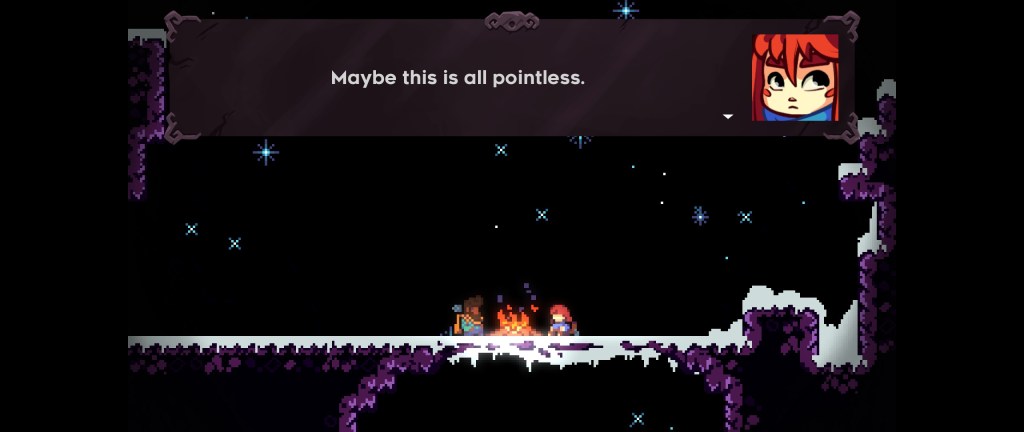
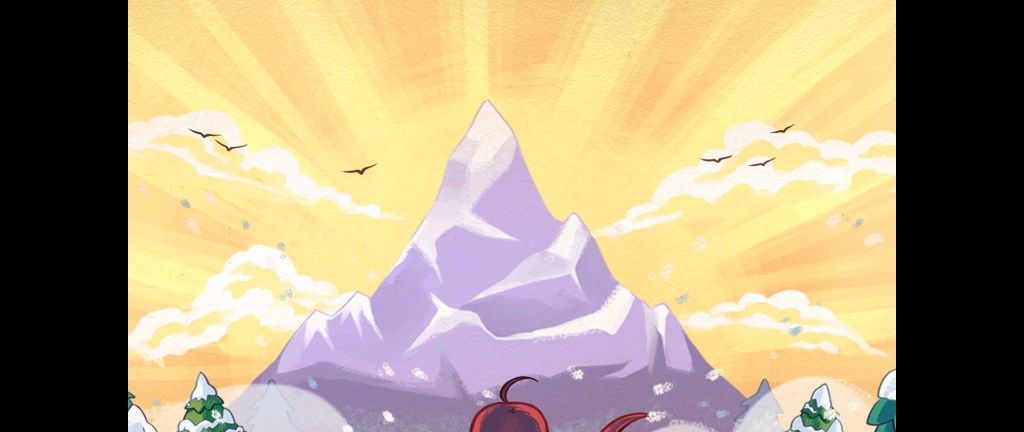
Celeste is a retro-style platformer developed by Maddy Makes Games and EXOK Games. By now, Celeste has garnered so much love and accolades as an indie game, that it really needs no introduction. It’s popular enough that I thought it outside the scope of this blog project I’ve got going on. Still, I tried it out for the first time recently, and the earnestness of the story along with the gameplay got me thinking about my life in a way that I think indie games do best.
The game stars Madeline, a young woman who, in a last-ditch effort to get herself out of a depressive funk, ventures out to climb the titular mountain, Celeste. As she ascends through screen after screen of progressively more hazardous platforming puzzles, Madeline slowly reveals why she feels the need to climb. She suffers from severe panic attacks and depression, and we see from an early dream sequence that she’d been struggling in her relationships, likely due to these panic attacks. At her lowest point, Madeline decides that in order to feel like she’s still worth something, she must overcome a difficult obstacle. Specifically, a treacherous mountain.
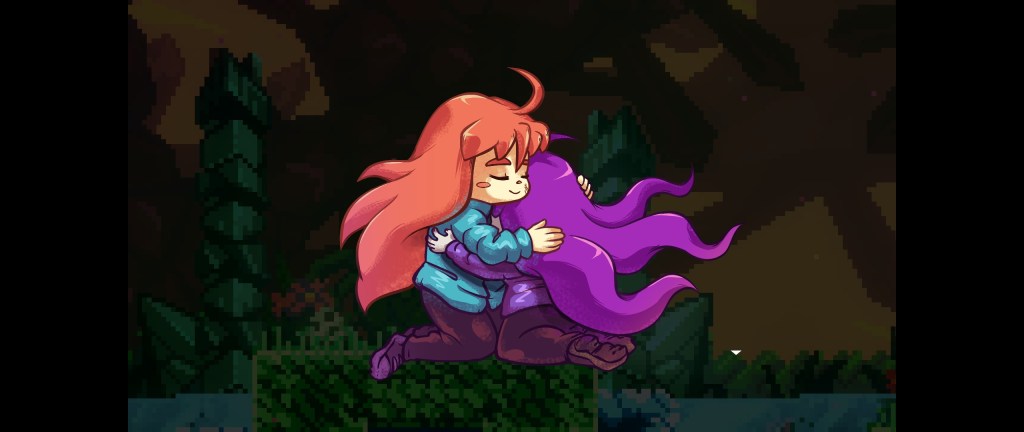
In turn, the mountain reveals to Madeline what she must do to overcome herself and, therefore, itself. Through a magical mirror, the mountain reveals a “part of Madeline.” This “Part of Her” is the deep-seated fear within Madeline that causes her to doubt herself and, worse, to lash out at herself and others. Much of the game is spent running away from this “Part of Madeline” or away from some outside danger brought about by this part’s tantrums. At first, Madeline tries to remove this frightened part of herself entirely. But when that only causes her fear to fight for control harder and ultimately drag her back down the mountain, she realizes that she must accept that part of herself and work together with it, instead. It’s only after acknowledging her fears and doubts as an integral part of herself that she gains the confidence in herself that she needs to finally reach the summit of Celeste.
Lying in my bed, nearing the end of a university semester that I had failed entirely, I slowly decided that I needed a clean break away from where my life was headed. I remembered an old childhood dream I had of moving to Japan. Not so much of a “dream,” really. It felt more like a pull. I figured the best way to get me out of this funk was to follow that pull and teach English in Japan. I wrote that college semester off as a loss, changed my major one last time to English, and dedicated the next year and a half to saving money for a one-way plane ticket. I was terrified the whole time, but desperate to make something in my life go right.

Life in Japan had kind of a rocky start. I got my first job easily enough, but in that job, I was so nervous. I taught with this harsh, stone-faced facade and scared a lot of my students away, which ended up giving me abysmal ratings. So much so, that my manager had to come up to me and warn me that if I didn’t turn things around, I’d have to be let go. From my first job in a foreign country. I quickly found myself in a familiar position on the bed in my apartment. That manager did give me some great advice, though, simple as it was. He just told me to have fun. It took me a while to get it, but I realized that I’d spent so much effort worrying about achieving success, that I completely forgot to enjoy myself. And that worry, that fear, showed on my face and in my demeanor and drove people away.
I still don’t understand it fully, but something clicked when I realized that. So I started to allow myself to be more vulnerable and to have fun. I laughed and joked with my students. My gestures opened up, and I felt freer in general. My instructor rating shot up so fast, that by the end of the year, I was the highest rated instructor in my region. I even got a little pin from the company as an award.
What I like most about Celeste is how it ties together its main character’s central drive, to accomplish something impossibly difficult in order to prove herself, with the game’s actual difficulty. Through failure after failure, we inevitably come closer to understanding Madeline’s struggle to find her confidence. The game even offers a plethora of extra challenges through strawberries, B-sides, C-sides, golden strawberries, and probably more that I haven’t seen yet. And the only real reason any given player has for attempting these challenges is prove themselves capable of doing so. It’s the same reason I imagine most people have for playing through other notoriously difficult games, like Dark Souls and Cuphead. It’s the same reason I had for diving into League of Legends and ultimately the same reason I had for moving to Japan. I can certainly tell you that I spent many deaths going after strawberries just because I didn’t want to give in to that fear that I saw come out of Madeline.
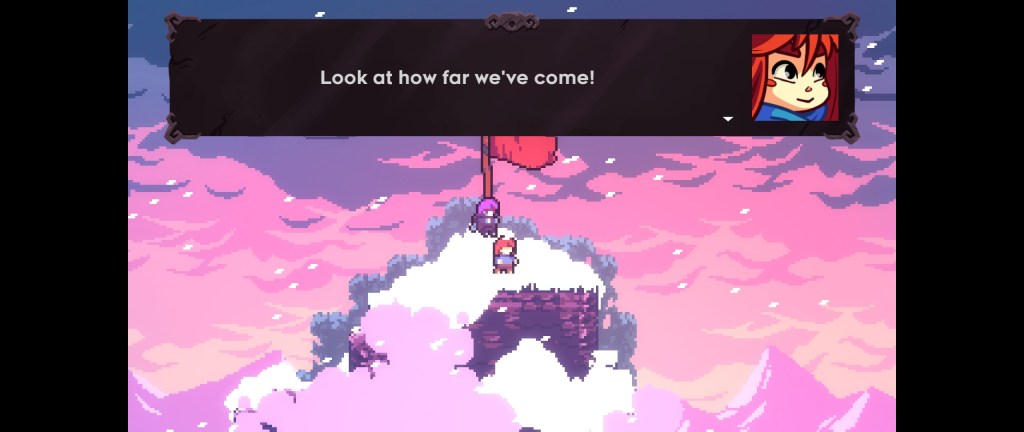
After you beat the main story, and Madeline reaches the summit, she returns to Celeste years later, complete with the power she gains from accepting the scared part of herself. There’s a new part of the mountain that has opened up for her to explore. Likewise, I have gone back and forth from teaching in Japan, and now I’m pursuing a career in acting. We still carry that fear and that lingering uncertainty within ourselves. But now we accept them as a part of who we are, and we allow ourselves to use that fear as motivation. I haven’t unlocked The Core yet, but when I do, I’m confident I’ll be up to the challenge.
 8-bit Grapevine
Leave a comment